Why Trading Signals Get Lost and How Retries + Delivery Logs Fix It
Why do trading signals get lost in transit? This post breaks down the common causes of missed alerts and explains how SignalTo uses auto-retries, dead-letter fallback, and full delivery logs to reliably deliver TradingView alerts to Telegram, Discord, and Feishu.
 SignalTo Team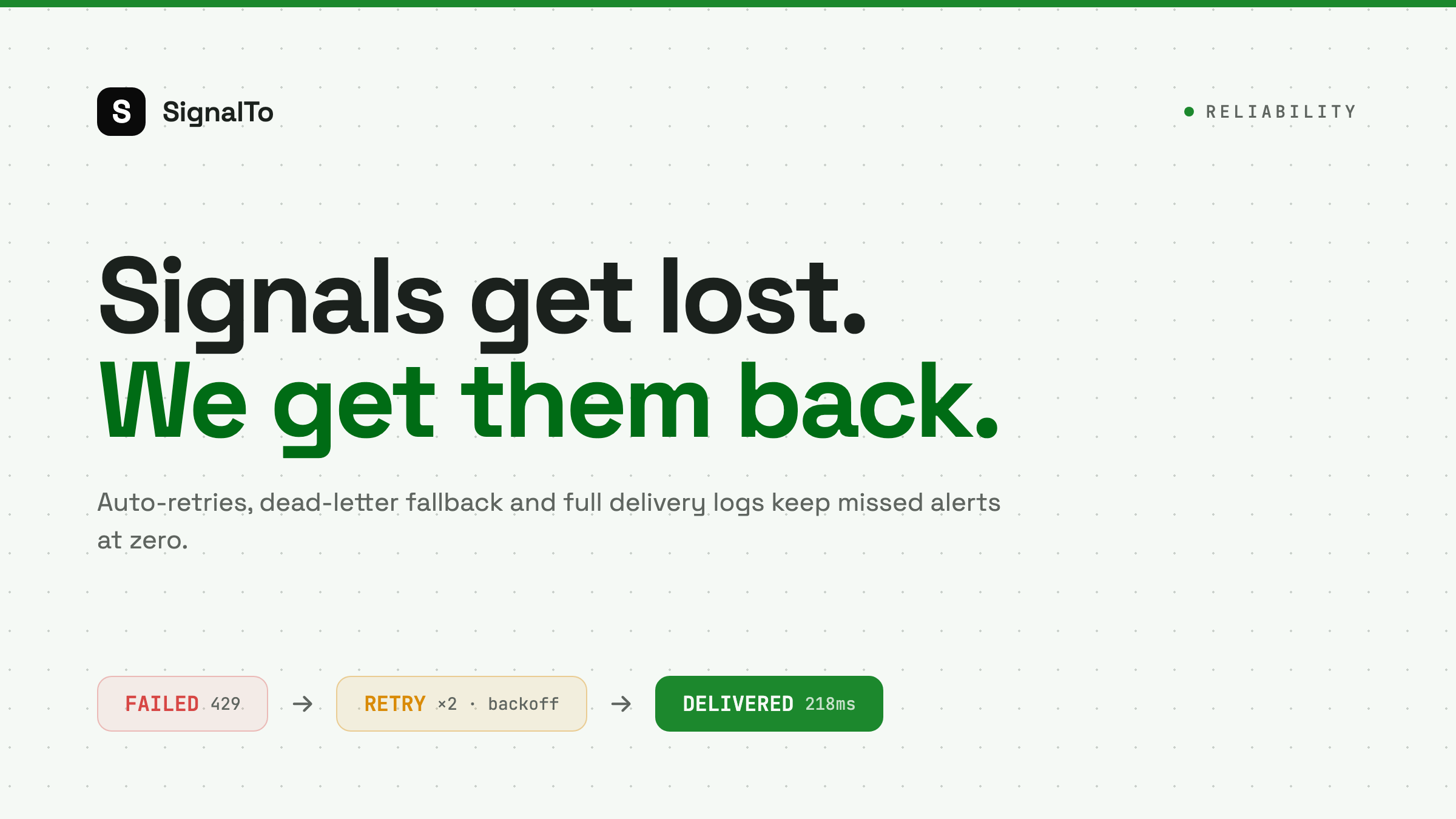
For traders, the worst feeling isn't a missing signal. It's a signal that fired but never arrived. An alert that should have told you to enter or exit quietly got lost somewhere along the way, and by the time you notice, it's too late.
This post explains where signals actually get lost, and how a reliable forwarding system (like SignalTo) keeps that loss as close to zero as possible.
Where signals usually get lost
Getting a TradingView alert to your chat takes several hops, and each one can fail:
- Network blips: a timeout the instant TradingView pushes to the forwarding service.
- Rate limits: Telegram and Discord both throttle sends; once tripped, requests get rejected.
- Transient failures: a brief 5xx from the target platform, a bot kicked from a group, an expired webhook.
- Duplicate triggers: the same candle firing repeatedly, spamming your group.
- Silent failures: the message never goes out, and no one ever sees an error. This is the most dangerous kind.
Sending once and forgetting is the classic flaw of "I'll just script it myself" setups. The real problem isn't the occasional failure. It's that nothing recovers from it, and nothing records it.
Three lines of defense for reliable delivery
SignalTo fights all of the above with three layers.
1. Automatic retries (with backoff)
One failed send doesn't mean the signal is gone. SignalTo retries automatically with backoff, gradually spacing out attempts so it doesn't pile on during a rate limit. Most transient failures heal themselves on retry.
2. Dead-letter fallback
If retries are exhausted, the message isn't silently dropped. It lands in a failure archive. You can see stuck messages in the dashboard, fix the cause (a bot permission, say), and resend with one click, instead of losing it forever.
3. Full delivery logs
Every signal has a searchable record: the raw payload, the parsed fields, which chat it went to, when, whether it succeeded, and how many retries it took. When something breaks, you can pinpoint exactly which hop failed instead of guessing.
Two classic headaches it also solves
- De-duplication: idempotent handling of inbound alerts means that even if TradingView pushes the same alert twice, it's sent once. No group spam.
- Multi-target consistency: when one signal goes to several platforms, each target retries and logs independently. A Discord failure never drags down your Telegram delivery.
Wrap-up
Whether signals get lost comes down to what the forwarding system does after a failure. Auto-retries heal transient errors, dead-letter fallback makes stubborn failures recoverable, and delivery logs make everything traceable. Together, those three are what "guaranteed delivery" actually means in engineering terms.