Self-Hosted Webhook Bot vs Managed Forwarding: The Real Math for Traders
Should you forward TradingView alerts to Telegram/Discord with a DIY Cloudflare Worker or VPS script, or use a managed service? No hype either way — this post does the honest math across maintenance cost, reliability, and the hidden time tax to help you decide.
 SignalTo Team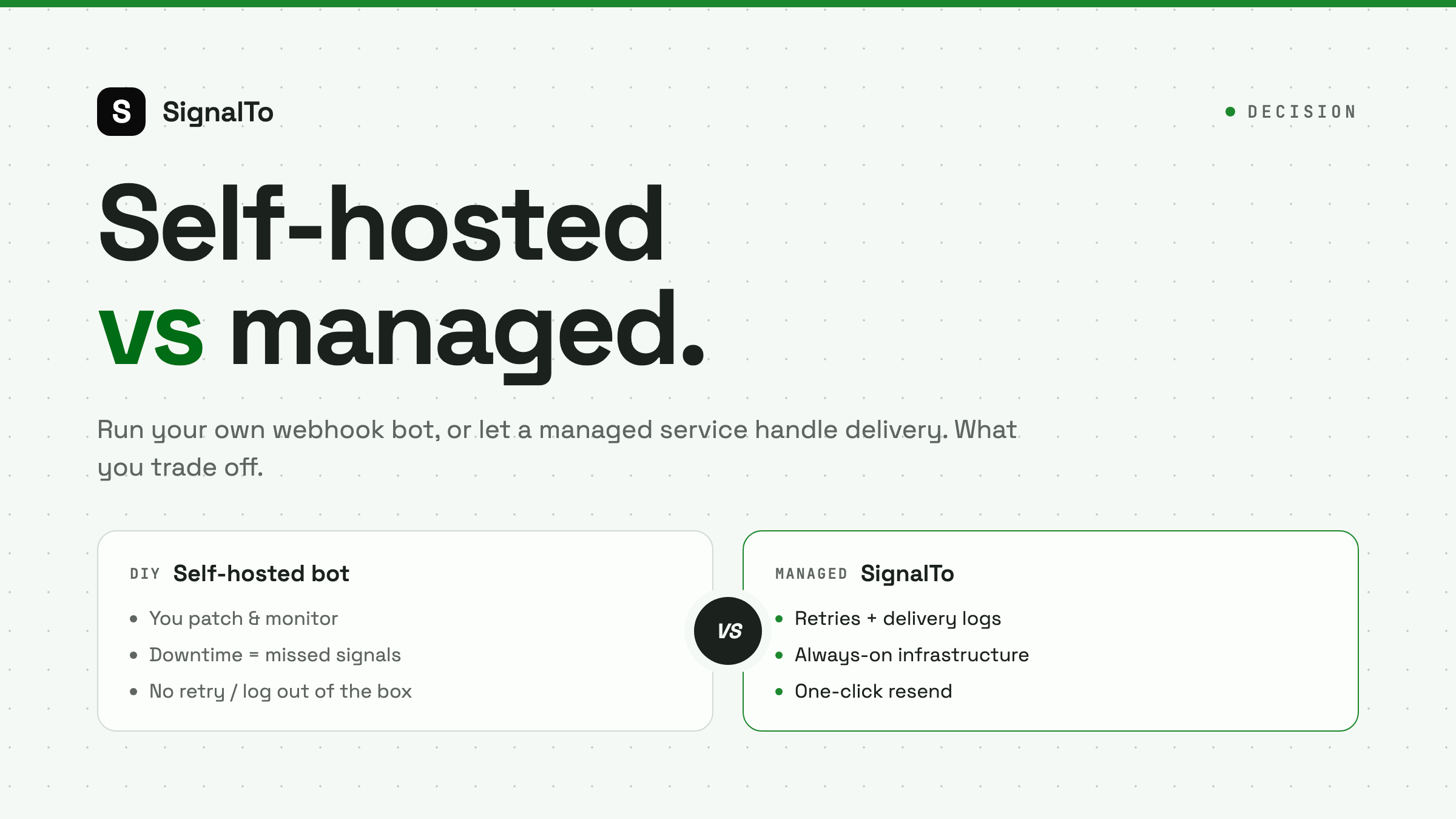
Search around for how to forward TradingView alerts to Telegram or Discord and the options split into two camps:
- Build it yourself: a few dozen lines on a Cloudflare Worker, or rent a VPS and run the open-source
TradingView-Webhook-Bot; - Use a managed service: sign up, grab a receiving URL, paste it in, done.
Most people's gut reaction is "this is simple, I'll just build it myself and save money." That call is correct on day one — but it leaves the rest of the bill off the table. This post lays that bill out honestly.
Building it yourself feels great on day one
Credit where it's due — the DIY route has real advantages:
- Cheap or free: Cloudflare Worker free tier is plenty for personal use; a VPS is a few dollars a month;
- Full control: the code is yours, change anything, no third party touches your data;
- No vendor lock-in: don't want it anymore? Just turn it off.
If you're just nudging yourself about one strategy and you don't care if a message drops now and then, DIY is genuinely fine — you can stop reading here.
But "it runs" and "it's reliable" are two different things
Here's the catch: with alert forwarding, the hard part isn't sending the message — it's what happens when it fails to send. None of the following are handled by a DIY setup out of the box:
1. VPSs go down, usually when you need them most
A reboot, a crashed process, a full disk, a datacenter hiccup — any one of these silently takes your bot offline. And you won't get a "the bot is down" notification — you'll just discover, during some later review, that not a single signal from that move arrived. Dying at 3 a.m. with nobody watching is the DIY route's most fatal weakness.
2. No automatic retries
Rate limits, transient 5xx, network blips — these are self-healing failures: retry once and they usually go through. But most open-source scripts are "send once, give up on failure." So messages that could have been saved are simply lost.
3. No audit trail, so you can't diagnose anything
Message didn't arrive — did TradingView not push it? Did the script not receive it? Did Telegram reject it? A DIY setup usually keeps no record, so you're left guessing at thin air. By the time you decide to add logging, you've already missed the signal that mattered.
4. No dedup, easy to spam
TradingView re-pushes the same alert on a network hiccup; a misconfigured once_per_bar fires repeatedly. With no idempotent dedup, your chat gets spammed with the same signal.
5. The 3-second timeout, which most scripts don't clear
As covered in the previous post: TradingView requires the receiver to respond within 3 seconds or it's marked failed. The fix is "return 200 first, forward async after." But quick scripts almost always process synchronously — fine on a quiet day, but they start dropping messages the moment traffic spikes or a downstream gets slow, and it's hard to pin down.
The real cost is time
DIY looks cheap on paper, but it just shifts the cost from "money" to "your time and attention":
- First-time build and debug: half a day to a day;
- Every platform API change, dependency bump, or expired cert afterward: your problem;
- Every mysterious dropped message: you add logging, reproduce, investigate;
- The most expensive line item: a critical signal got lost and you never noticed — that one can't be priced in dollars.
If you take trading seriously, your attention belongs on strategy and the market, not on babysitting a forwarding script.
A side-by-side table
| Dimension | DIY (Worker / VPS script) | Managed forwarding |
|---|---|---|
| Setup cost | Write code / configure a server | Paste a URL and go |
| Monthly cost | Free–a few dollars | Usually has a free tier |
| Auto-retry | Build it yourself | Built in |
| Audit trail / diagnosable | Add your own logging | Full record built in |
| Inbound dedup | Build it yourself | Built in |
| 3-second timeout handling | Easy to get wrong | Handled (accept then forward) |
| Anyone watching when it breaks? | No, you watch it | The platform does |
| Multi-platform / multi-chat | Write your own routing | Configure it |
| Best for | Tinkerers OK with occasional drops | Want it hands-off, signals must arrive |
How to choose: a simple test
- Go DIY if you enjoy tinkering, you're only serving yourself, and you can live with losing a message now and then. That's a perfectly reasonable choice.
- Go managed if you take trading seriously and signals can't be missed — or if you're sending signals to a community or team. When other people are waiting on your signal, reliability isn't a nice-to-have, it's the floor.
That's the path SignalTo takes: a ready-to-use receiving URL with HTTPS built in, instant response, inbound dedup, automatic retries, a full delivery record for every message, and multi-platform/multi-chat routing configured in one place. All the grunt work a DIY setup ignores, handled for you.